


 English
 Français
 Español
 Deutsch

Home · News · Industry News · How Cooling System Design Affects Injection Mold Efficiency | Fanze T&M
Industry News
How Cooling System Design Affects Injection Mold Efficiency | Fanze T&M
2026-10-07Table of Contents
- 1 Cooling Time Dominates the Injection Molding Cycle
- 2 Uniform Cooling Determines Part Quality Before Cycle Time Does
- 3 Channel Layout: Conventional Lines, Conformal Lines, and the Trade-Offs
- 4 Mold Material and Coolant Choice Shift Cooling Performance
- 5 Make Cooling System Design Part of Your Mold Sourcing Review
Cooling Time Dominates the Injection Molding Cycle
For a typical injection molded part, cooling takes longer than filling, packing, and ejection combined. On automotive interior trim and similar medium-wall parts, that share usually sits between 60 and 80 percent of the total cycle. This is why, when a mold misses its quoted cycle time or a part shows inconsistent dimensions, the cooling design is the first thing an experienced mold maker examines. The conclusion is simple and runs through everything in this article: the cooling circuit determines how fast each part can be made and how closely it matches the print, so it deserves the same review effort as cavity layout and gating.
The mechanics behind that claim are not complicated. Polymer enters the cavity at a melt temperature of roughly 200-300 °C, depending on the grade, and the part surface must fall to a safe ejection temperature before the mold opens. The polymer wall conducts heat poorly, so the rate of cooling is controlled by how quickly heat can leave each section of the part and reach the coolant. Fast but uneven cooling gives you short cycles with warped parts; slow but even cooling gives you dimensional stability at the cost of production rate. The job of the cooling system designer is to make those two goals converge.
Uniform Cooling Determines Part Quality Before Cycle Time Does
Cooling that is fast but uneven produces a familiar list of defects: warpage from differential shrinkage, sink marks over thick ribs, residual stress that appears later as dimensional drift, and gloss differences on textured or painted surfaces that fail at final inspection. Ejection also becomes less predictable because an overheated core holds the part while the cavity side releases it.
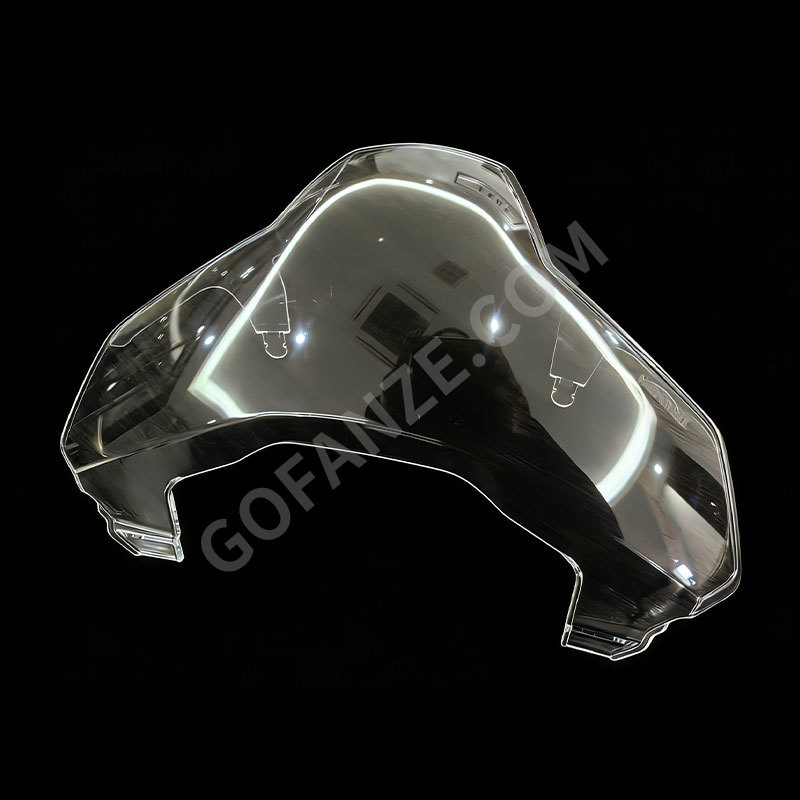
No product family is more sensitive to this than high-clarity optical parts. A motorcycle clear windshield injection mold, for example, must keep the cavity temperature within a few degrees across the whole optical zone. If it does not, the transparent polycarbonate freezes at slightly different rates and the result is visible haze or flow lines even when gating and filling are correct. The same discipline applies to headlight lenses and transparent decorative parts, and the practical rules we apply on such tools are collected in our technical note on high-gloss transparent PC injection mold design for optical and clear parts.
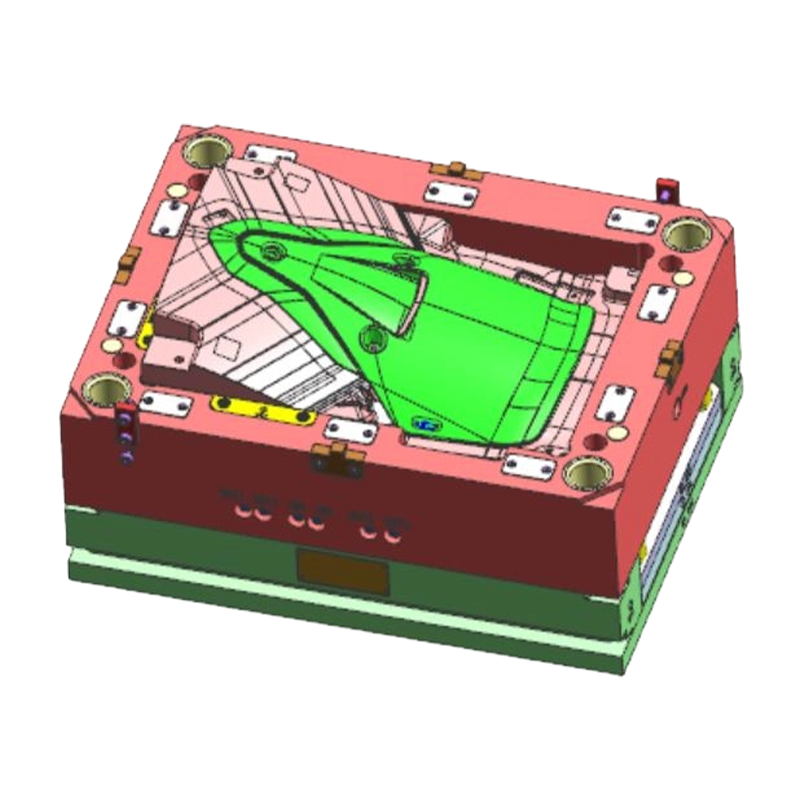 Wholesale Motorcycle Clear Windshield Injection Mold Suppliers, Company, ExporteFanze T&M (Jiashan) Co., Ltd. Is China Wholesale Motorcycle Clear Windshield Injection Mold Suppliers, Company, Exporter, This product is...View Product →
Channel Layout: Conventional Lines, Conformal Lines, and the Trade-Offs
Most injection molds still use straight-drilled cooling lines, and for simple geometry that is the right choice: they are inexpensive to machine, easy to clean, and simple to verify. The limitation appears when the cavity surface is curved, deep, or surrounded by thin cores. Straight holes cannot keep a constant distance from the contour, so the deepest points of the cavity stay hot while areas near the parting line run cold.
Conformal cooling routes the channels to follow the part shape, usually with additively manufactured inserts or, in simpler cases, angled and stepped drilled lines. In trials on deep-cavity shells, conformal layouts typically reduce cooling time by 15 to 40 percent compared with straight lines, because the distance between channel and cavity surface stays uniform. The trade-off is cost: printed inserts take longer to produce, need a simulation-driven design, and require careful cleaning because small printed channels collect scale deposits.
| Parameter | Recommended starting value | Why it matters |
|---|---|---|
| Channel diameter | 8-12 mm for medium-size parts | Balances heat removal capacity against machining cost. |
| Distance from channel center to cavity surface | 2-2.5 times the channel diameter | Keeps the mold wall stiff while allowing heat transfer. |
| Pitch between adjacent channels | 3-4 times the channel diameter | Prevents temperature peaks between neighboring lines. |
| Coolant flow regime | Turbulent flow, Reynolds number above 4,000 | Ensures heat is carried away by the fluid instead of pooling. |
| Coolant temperature | 10-15 °C below the target mold temperature | Controls shrinkage consistency and cycle stability. |
For most production projects, the practical answer is hybrid rather than all-or-nothing: straight-drilled lines through the main blocks, conformal inserts only where the geometry demands uniform temperatures, and a water-line diagram approved before steel is cut.
Mold Material and Coolant Choice Shift Cooling Performance
Tool steel grade is the second lever. P20-class steels conduct heat at roughly 29 W/mK, and H13-class steels are similar. Beryllium copper inserts conduct heat roughly four times better, which is why they are placed behind ribs, bosses, and other thick sections that naturally cool more slowly. Used selectively, a high-conductivity insert can stop one heavy wall section from dictating the cycle time of the entire part.
Coolant selection deserves the same attention. Water is the default because of its heat capacity, but high-cavity-temperature applications, such as the 80-120 °C mold faces used for some high-gloss surfaces, may need a separate temperature control unit and a wider channel layout. Practical details create most of the difference: every water line should be individually verifiable with a flow meter, quick couplings should be sized so they do not throttle the circuit, and the cooling plan should state the water temperature and flow rate assumptions that the cycle estimate is based on.
Make Cooling System Design Part of Your Mold Sourcing Review
A cooling circuit is also a procurement decision. When a customer asks us to quote an automotive instrument panel frame injection mold, the cooling review starts before the steel order is placed. The same logic applies to large housings such as a EV charging pile shell with screen injection mold, where a visible surface, long flow length, and tight dimensional callouts force the cooling design to work together with gate placement instead of after it.
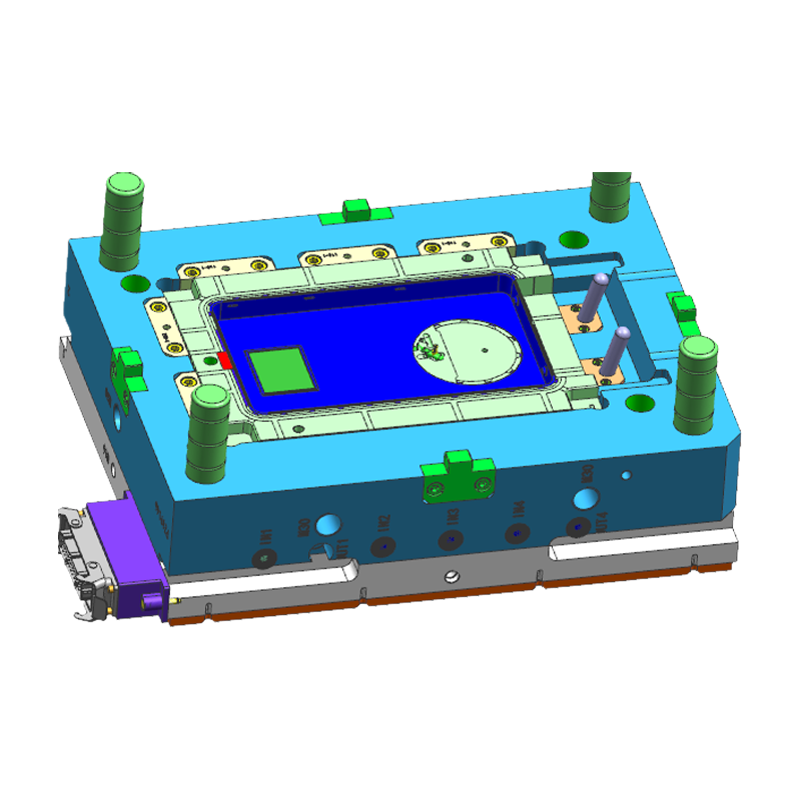 Wholesale Charging Pile Shell With Screen Injection Mold Suppliers, Company, ExpFanze T&M (Jiashan) Co., Ltd. Is China Wholesale Charging Pile Shell With Screen Injection Mold Suppliers, Company, Exporter, This produc...View Product →
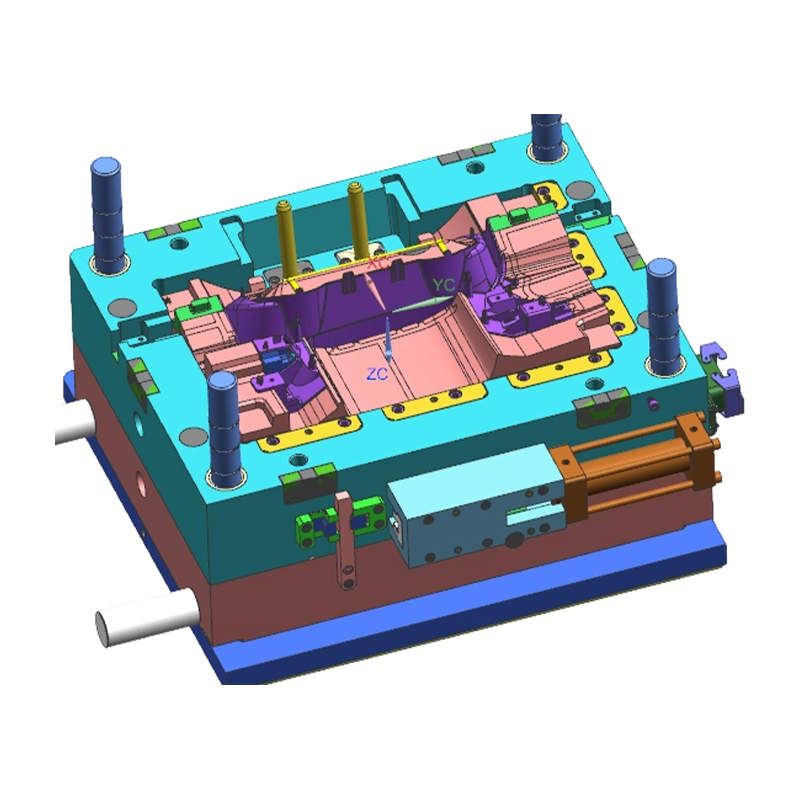 Wholesale Instrument Panel Frame Injection Mold Suppliers, Company, ExporterFanze T&M (Jiashan) Co., Ltd. Is China Wholesale Instrument Panel Frame Injection Mold Suppliers, Company, Exporter, This product line sp...View Product →
What to verify before committing to a mold supplier
- A mold flow analysis report that includes the cooling phase, not just fill and pack. It should show the predicted part temperature at ejection and the temperature variation across the cavity surface.
- A written cycle time estimate with the cooling assumptions stated: water temperature, flow rate, mold steel grade, and acceptable pressure drop through the lines.
- A water-line diagram showing channel diameter, pitch, distance to the cavity surface, and access for cleaning and future repair.
- A plan for heat spots, with the cooling of thick ribs, inserts, and deep cores addressed without overcooling adjacent thin sections.
For automotive-grade work, these documents become part of the process quality review under the IATF 16949 system, which is one reason Fanze T&M structures its mold engineering this way. The material and design logic behind our automotive interior work is covered in our article on automotive interior plastic parts mold design principles and material selection, and the housing-specific considerations are in our EV charging station injection mold design and materials guide.
The takeaway for your next mold project
Cooling system design is not an internal detail hidden inside the mold. It is the main lever for cycle time, dimensional consistency, and the visible quality of an injection molded part. A mold that cools evenly will produce parts at a predictable rate, hold its dimensions over a long run, and keep scrap from reaching the inspection station. Fast filling without a matched cooling layout only moves the problem from the molding phase to the ejection tray.
Categories
- Company News(2)
- Industry News(32)
Product Category
-
Printer Components & Parts
-
Two-color Plastic component & tool
-
Plastic Multi-way Connectors
-
Threaded Plastic injection molded part
-
Home Appliance Injection Parts
-
Robot shell injection mold
-
High-Gloss Transparent PC injection mold
-
Motorcycle Fairings & Bodywork plastic injection mold
-
EV Charging pile plastic injection mold
-
Automobile wire harness
-
Automotive interior plastic parts injection mold
Related Tag
-
Transparent PC Light Cover Injection Mold
Automotive Interior Trim Plastic Parts Injection Mold
Motorcycle Instrument Panel Injection Mold
Multi Cavity Automotive Interior Plastic Parts Injection Mold
Automotive Dashboard Plastic Parts Injection Mold
Automotive Door Panel Plastic Parts Injection Mold
Plastic Pipe Connector Injection Mold
Motorcycle Headlight Housing Mold
EV Charger Enclosure Injection Mold
Automotive Dashboard Injection Mold


- Automotive interior plastic parts injection mold
- Automobile wire harness
- EV Charging pile plastic injection mold
- Motorcycle Fairings & Bodywork plastic injection mold
- High-Gloss Transparent PC injection mold
- Robot shell injection mold
- Home Appliance Injection Parts
- Threaded Plastic injection molded part
- Plastic Multi-way Connectors
- Two-color Plastic component & tool
- Printer Components & Parts

