


 English
 Français
 Español
 Deutsch

Home · News · Industry News · Trumpet Airbox Injection Mold: Key Design and: Practical Applications, Selection
Industry News
Trumpet Airbox Injection Mold: Key Design and: Practical Applications, Selection
2026-10-16Table of Contents
An engine calibration engineer sees a repeatable 3 percent torque loss at 7,000 rpm on a new 450 cc single-cylinder prototype. The throttle body, cam profile, and fuel mapping are all correct. The root cause is the trumpet airbox: its internal volume and velocity stack length drifted because the injection mold was built with loose tolerances. That failure pattern is common enough that serious motorcycle programs treat airbox mold geometry as an engine specification, not a cosmetic afterthought.
The trumpet airbox sits between the air filter and the throttle body, feeding clean air while using resonant pressure waves to improve cylinder filling at selected rpm. For the mold engineer, purchasing manager, or project lead, the practical questions are which design parameters change real engine behavior, and which supplier capabilities keep those parameters stable across production batches.
What a Trumpet Airbox Injection Mold Controls
A trumpet airbox injection mold produces a sealed intake housing whose internal volume, stack geometry, and sealing surfaces directly determine torque delivery, intake noise, and service life.
A trumpet airbox is a sealed intake plenum that combines a resonant air chamber with one or more velocity stacks - trumpet-shaped tubes - to tune air pressure pulses before they reach the throttle body.
Three mold-controlled features carry most of the performance risk. Internal plenum volume sets the acoustic resonance frequency of the intake tract; on a 450 cc single, a typical working volume of 6 to 9 liters makes even a plus or minus 1 percent volume error visible on the dyno. Stack geometry, including bell mouth radius and stack length, controls the engine speed at which peak torque appears. Sealing flange flatness prevents unfiltered air and water ingress, a common durability failure on adventure and enduro bikes. Threaded inserts and mounting bosses also need positional accuracy within plus or minus 0.1 mm so assembly on the engine line does not pre-load the housing and cause stress cracks.
Key tolerance: a 5 mm change in velocity stack length can move the torque peak by 300 to 500 rpm. Write these tolerances into the mold technical agreement, not just the part drawing.
Core Design Rules for the Mold
Five mold design decisions determine whether a trumpet airbox passes leak, dimensional, and flow checks on the first trial.
- Target wall thickness between 2.5 and 3.0 mm and keep variation below 0.2 mm between adjacent sections. Uneven walls create sink marks on visible surfaces and warpage on the sealing flange, both of which turn up late in validation.
- Apply 1 to 1.5 degrees of draft on deep side walls, and increase to 2 degrees wherever a gloss texture is specified. The intake side often pairs a fine texture with low draft, making that steel surface the most difficult polishing area in the cavity.
- Plan side actions for undercuts before cavity cutting begins. Breather channels, mounting bosses, and stack-locating ribs usually force the parting line deeper into the part, requiring hydraulic side actions or angled lifters with cooling lines routed inside the mold base.
- Set gate position to balance filling without placing a weld line across the stack mounting face. A single tunnel gate near the lower sealing flange works for symmetrical housings; asymmetric parts typically need a hot runner with two drops.
- Use conformal cooling near the deep stack cores. Conformal channels can cut cycle time by up to 20 percent compared with straight-drilled lines and reduce the part temperature spread that causes post-mold shrinkage.
Gate rule: if the weld line must cross the stack bore, make sure the mold flow analysis shows the weld line landing below the bell mouth radius, where it will not disturb airflow.
These five rules follow general injection mold design and manufacturing principles, and they become stricter when the part is a tuned intake component that also has to seal against dust and water.
Material Selection and Trade-Offs
Material selection for a trumpet airbox balances heat deflection, fuel and oil resistance, weld-line strength, and cost, with glass-reinforced polyamides dominating performance programs.
The airbox mounts close to the cylinder head, so the plastic sees radiated heat, vibration, fuel vapor, and oil mist. PA66-GF30 delivers the highest mechanical strength and fatigue life, making it the default for racing and enduro use. PA6-GF30 offers a better impact-to-stiffness balance at lower cost, which is why most sport and naked bike programs specify it. PP+EPDM keeps weight and cost down on commuter platforms, while ABS suits low-warp, Class A cosmetic parts with moderate heat exposure.
| Material | HDT (C) | Key Strengths | Typical Program |
| PA66-GF30 | 250 | Highest strength, fatigue resistance | Racing, enduro |
| PA6-GF30 | 210 | Balanced impact and stiffness | Sport, naked |
| PP+EPDM | 100 | Low cost, low density | Scooter, commuter |
| ABS | 95 | Good finish, low warpage | Entry-level models |
Heat deflection temperature by airbox material grade. Higher is better for engine-adjacent mounting.
Shrinkage warning: glass fiber raises stiffness and heat resistance but increases anisotropic shrinkage. Cavity dimensions on a trumpet airbox mold must be cut from measured shrinkage data of the chosen grade, never from generic material tables.
Practical Applications Across Motorcycle Segments
Trumpet airbox injection molds serve sport, adventure, and commuter segments, with geometry and material shifting according to tuning targets and production volumes.
- Sport and naked motorcycles: long velocity stacks for high-rpm power, PA6-GF30 or PA66-GF30, Class A visible surfaces, and hot runner molds for multi-cavity output.
- Adventure and enduro: reinforced ribs, sealing faces designed for repeated water crossings, and higher impact grades that survive crashes, luggage loads, and maintenance access.
- Scooter and commuter: compact clamshell packaging, PP+EPDM resin, simplified side actions, and pre-hardened tool steel to keep mold cost aligned with lower piece volumes.
The direct product page for this tooling shows how cavity layout, side actions, and surface finish are handled for intake housings.
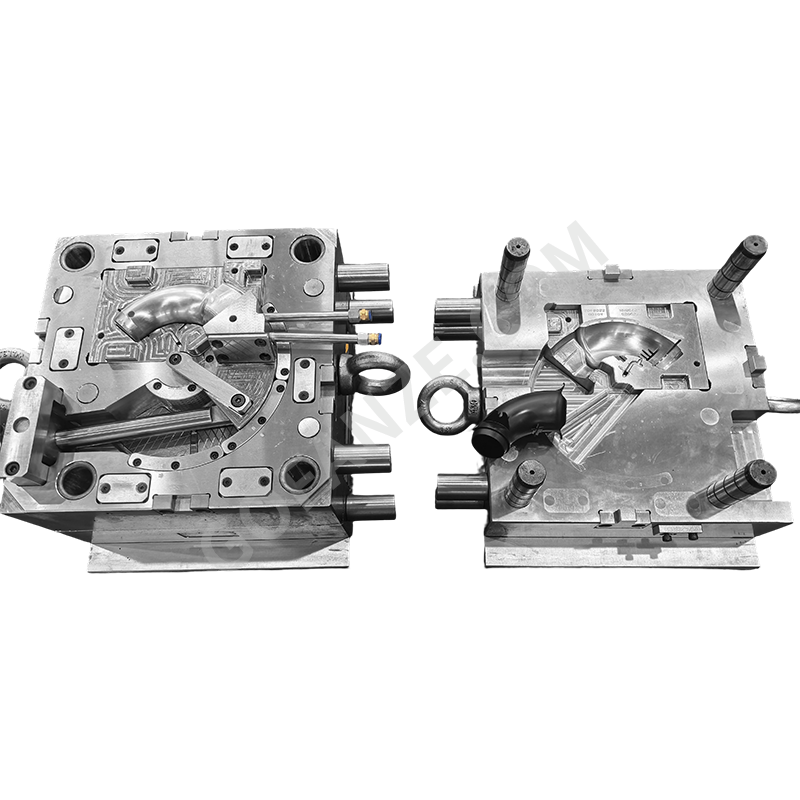 Injection Mold for Motorcycle Horn Air Intake and Bodywork ComponentsThis mold focuses on precision cavity layout, side actions, and surface finish for intake housings, with venting and gate design to prevent weld lines and gas marks while supporting ABS or PP parts and custom OEM requirements.View Product →
Real impact: a 0.5 mm deviation on the bell mouth radius can reduce intake flow at peak valve lift by roughly 2 percent. On a 100 hp engine, that is about 2 hp lost before the ECU sees it.
The same mold builder should also handle the intake port and other air-path components. Keeping the airbox, intake port, and air filter housing in one engineering team ensures consistent shrinkage assumptions and matching sealing interfaces. For a complete view of available tooling, the motorcycle fairings and bodywork plastic injection molds range includes air intake ports, radiator guards, mudguards, and body cover sets.
How to Select a Trumpet Airbox Mold Supplier
Select a trumpet airbox mold supplier by verified mold flow capability, side-action experience, and automotive-grade process control, not by quoted price alone.
- Mold flow analysis reports that predict weld lines, air traps, and fill pressure before steel cutting, with the results reviewed by your engineering team.
- Steel packages matched to the program: 2738 or 718H pre-hardened steel for prototypes and low volumes, S136 or 8407 for high-volume production cavities.
- IATF 16949 certification, which brings PPAP discipline, process FMEA, and engineering change control into the mold program.
- In-house pilot molding, so cavity corrections are made and verified in the same factory instead of shipping the mold to a second molder.
- A reference list on intake-side motorcycle components, including air intake ports, fairings, filter housings, and airbox assemblies.
Supplier profile: Fanze T&M (Jiashan) Co., Ltd., founded in 2005 as Shanghai Fanze Precision Mold Co., Ltd., builds precision molds and molded parts under one roof. The Jiashan plant covers a 7,000 m2 site with about 14,000 m2 of usable floor space, employs roughly 100 people, and operates imported CNC, EDM, and wire-cutting machines alongside Japanese and German injection molding equipment.
For intake-side tooling beyond the airbox itself, review the air intake port mold as a companion component in the same front-end airflow path.
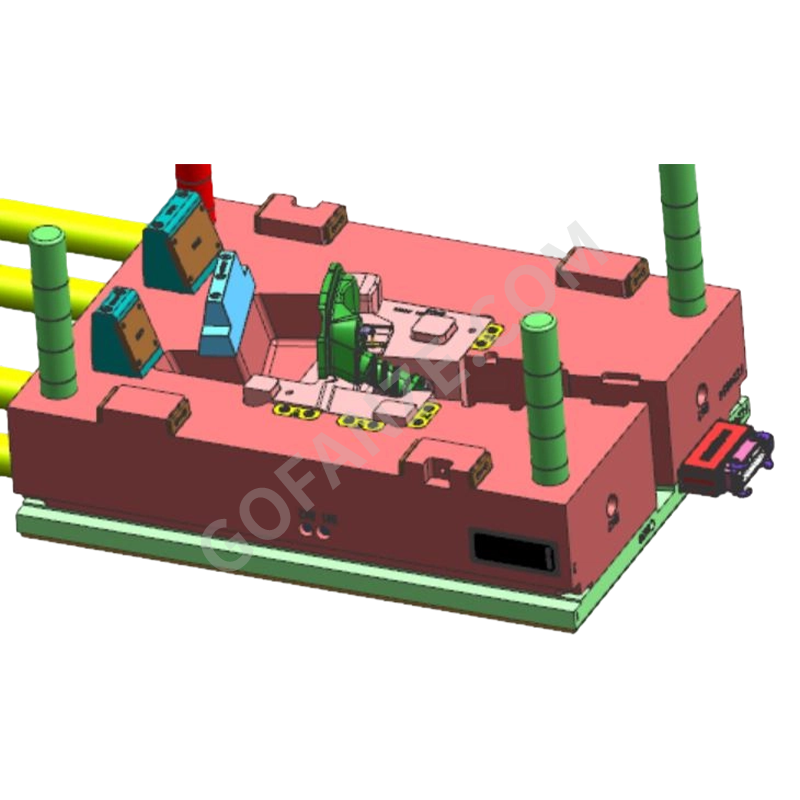 Customizable Injection Mold for Motorcycle Air Intake Ports and Outer ShellsThis mold serves intake-side tooling beyond the airbox, with over 15 years of export experience, customization from drawings or 3D models, and options for plastic welding and assembly to streamline production.View Product →
FAQ
What is a trumpet airbox in a motorcycle intake system?
A trumpet airbox is a sealed plastic plenum that combines a resonant air chamber with velocity stacks to tune intake pressure pulses. The injection mold that produces it controls the internal volume, stack geometry, and sealing faces that shape engine performance.
Which material is best for a trumpet airbox?
PA6-GF30 is the best overall choice for most performance motorcycles because it balances stiffness, impact resistance, and cost. PA66-GF30 suits racing and enduro parts with higher heat and vibration loads, while PP+EPDM fits cost-sensitive commuter platforms.
How do you verify a trumpet airbox mold before mass production?
Review the mold flow analysis, trial dimensional reports, CMM data on stack bores and mounting bosses, leak test results on the sealing flange, and weld line photographs. Suppliers operating under IATF 16949 normally compile these into a PPAP-style report.
Can one airbox mold serve multiple motorcycle models?
Only when engine tuning, mounting points, and packaging space are identical. Internal volume and stack length directly shift the torque curve, so most OEMs require model-specific cavity geometry even when the outer attachment points appear similar.
Final selection advice: when comparing quotes, ask every supplier for the same three documents: mold flow analysis, steel specification, and a trial schedule with defined dimensional and leak test criteria. The supplier that answers those three questions precisely is the one to visit first.
Categories
- Company News(2)
- Industry News(32)
Product Category
-
Printer Components & Parts
-
Two-color Plastic component & tool
-
Plastic Multi-way Connectors
-
Threaded Plastic injection molded part
-
Home Appliance Injection Parts
-
Robot shell injection mold
-
High-Gloss Transparent PC injection mold
-
Motorcycle Fairings & Bodywork plastic injection mold
-
EV Charging pile plastic injection mold
-
Automobile wire harness
-
Automotive interior plastic parts injection mold
Related Tag
-
Automotive Dashboard Plastic Parts Injection Mold
Automotive Door Panel Plastic Parts Injection Mold
Transparent PC Light Cover Injection Mold
Plastic Pipe Connector Injection Mold
Motorcycle Instrument Panel Injection Mold
EV Charger Enclosure Injection Mold
Automotive Dashboard Injection Mold
Automotive Interior Injection Mold
Rice Cooker Lid Injection Mold
Automotive Interior Plastic Components Injection Mold


- Automotive interior plastic parts injection mold
- Automobile wire harness
- EV Charging pile plastic injection mold
- Motorcycle Fairings & Bodywork plastic injection mold
- High-Gloss Transparent PC injection mold
- Robot shell injection mold
- Home Appliance Injection Parts
- Threaded Plastic injection molded part
- Plastic Multi-way Connectors
- Two-color Plastic component & tool
- Printer Components & Parts

