


 English
 Français
 Español
 Deutsch

Home · News · Industry News · How to Improve Automotive Injection Mold Service Life: A Practical Guide
Industry News
How to Improve Automotive Injection Mold Service Life: A Practical Guide
2026-08-26Table of Contents
- 1 The Four Failure Modes That End Automotive Molds
- 2 Choose Steel and Heat Treatment by Duty, Not by Habit
- 3 Apply Surface Treatments Where Wear Concentrates
- 4 Design Cooling for Uniform Thermal Load
- 5 Design Part and Mold for Process Stress
- 6 Run Preventive Maintenance, Not Breakdown Recovery
- 7 Frequently Asked Questions
Automotive injection mold service life is the number of production cycles a tool completes before part dimensions, surface finish, or process stability fall below specification. That number is decided before the first steel is cut: steel grade, heat treatment, surface coating, cooling layout, and maintenance discipline determine whether a tool delivers 300,000 cycles or crosses 1,000,000.
In a typical automotive program, an interior mold runs glass-fiber-reinforced PA66 or PC-ABS at cavity pressures above 800 bar. Under those loads, an unhardened P20 tool can lose its parting line in fewer than 200,000 cycles, while the same geometry hardened to 48 HRC and coated on the wear zones regularly passes 600,000 cycles. That gap is not luck; it is a set of engineering decisions.
Fanze T&M (Jiashan) Co., Ltd., a precision injection mold and molded-part manufacturer serving automotive programs since 2005, applies these disciplines on dashboard frames, HVAC vents, airbag housings, and structural brackets under an IATF 16949 quality system. Mold life is treated there as a tracked cost per part, not a maintenance surprise.
The Four Failure Modes That End Automotive Molds
Four mechanisms cause nearly all automotive mold replacements: abrasive wear, corrosion, thermal fatigue, and mechanical deformation. Identify which one dominates your tool, and you know which improvement will extend life the most.
Glass fibers act as a cutting medium on every shot, eroding gates, core edges, and parting lines. Corrosion follows when cooling water is untreated or when flame-retardant resins release acidic by-products. Thermal fatigue appears as micro-cracks in corners after tens of thousands of heating-and-cooling cycles. Deformation occurs when clamp tonnage or cavity pressure exceeds the strength of thin steel sections.
Parting-line wear is the first measurable sign of aging. Once flash appears, every repair removes metal, and remaining mold life shortens with each pass.
Choose Steel and Heat Treatment by Duty, Not by Habit
Steel selection is the highest-leverage decision for automotive mold life: match the grade to filler content, production volume, and surface finish requirement before designing cooling or coatings.
For structural parts molded in glass-fiber-reinforced resin, pre-hardened steel is a shortcut to early failure. H13 hardened to 48-52 HRC keeps cutting edges and thin core inserts intact for hundreds of thousands of cycles. For high-gloss interior surfaces, stainless S136 adds corrosion resistance and a polishability that resists wear and release-agent buildup.
| Steel grade | Hardness (HRC) | Glass-fiber compatibility | Typical service life | Common automotive use |
| P20 | 28-32 | Low | 200,000-400,000 | Prototypes, low-volume trims |
| 718H | 33-38 | Medium | 300,000-500,000 | Interior trim, HVAC vents |
| H13 | 44-52 | High | 500,000-800,000 | Airbag housings, structural brackets |
| S136 | 48-52 | High | 500,000-1,000,000 | High-gloss, transparent, corrosion-prone parts |
A large structural tool such as an instrument panel frame injection mold carries the same material-selection logic: the bigger the projected area, the higher the cavity-pressure load, and the worse the consequence of soft steel. The material choice also interacts with part geometry, as explained in our automotive interior mold design and material selection guide.
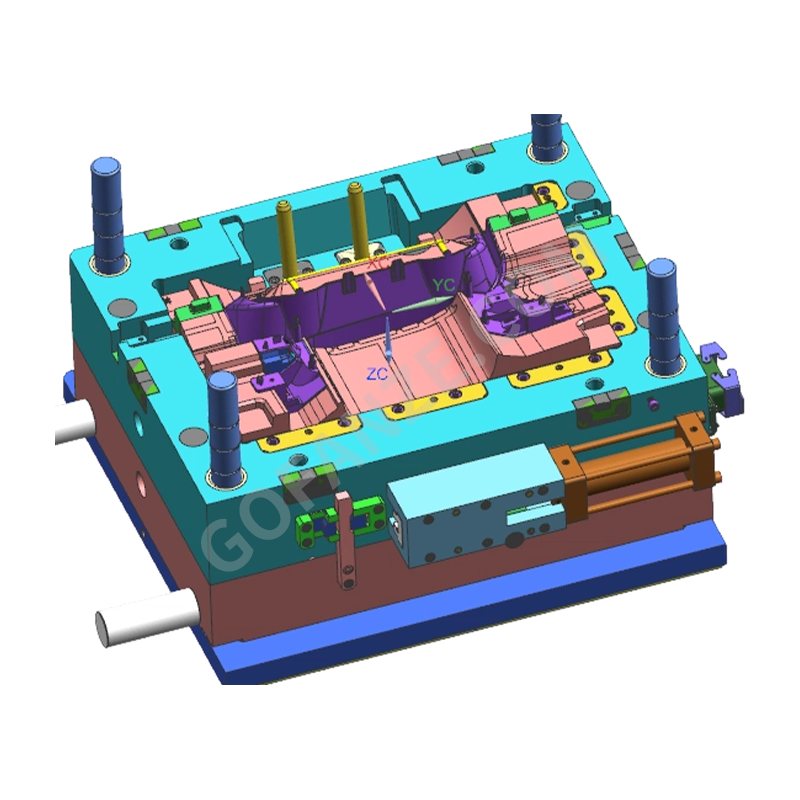 Wholesale Instrument Panel Frame Injection Mold Suppliers, Company, ExporterFanze T&M (Jiashan) Co., Ltd. Is China Wholesale Instrument Panel Frame Injection Mold Suppliers, Company, Exporter, This product line sp...View Product →
Above 30% glass-fiber content, never run a production tool below 45 HRC in the wear zones.
Apply Surface Treatments Where Wear Concentrates
Nitriding and PVD coatings raise surface hardness to a 70-90 HRC equivalent and can double cavity life on abrasive automotive resins.
Nitriding forms a hard diffusion case without changing dimensions, which makes it ideal for core pins and slides. PVD coatings add a thin, low-friction ceramic layer that reduces both wear and ejection force. Chrome plating remains a practical option for corrosion-dominated surfaces. The most cost-effective approach is selective: treat the gate area, the parting line, and the high-wear core faces, and leave the rest of the tool untreated.
Components such as an airbag mounting support bracket mold run in glass-filled PA66, where coated cores and gates hold critical dimensions far longer than bare steel at the same hardness.
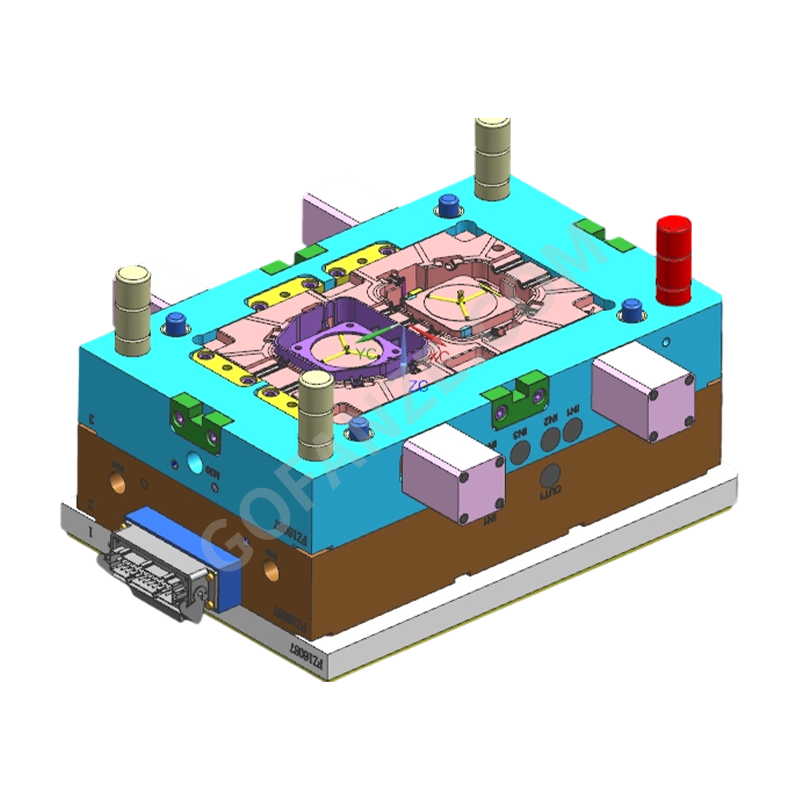 Wholesale Automotive Plastic Airbag Mounting & Support Bracket injection mold SuFanze T&M (Jiashan) Co., Ltd. Is China Wholesale Automotive Plastic Airbag Mounting & Support Bracket injection mold Suppliers, Company, ...View Product →
Design Cooling for Uniform Thermal Load
A balanced cooling circuit is a mold-life feature: keeping cavity-surface temperature variation under 10 degrees Celsius prevents heat fatigue and slows crack growth.
Thermal fatigue starts where surface temperature swings are largest, usually at the gate, at sharp corners, and around deep core inserts. Conformal cooling channels that follow the cavity contour remove heat evenly and reduce hot spots. Add cooling near the parting line and around ejector sleeves; every uneven zone becomes a future crack origin.
A well-cooled cavity also shortens cycle time, which changes the payback math: the same mold produces more parts per month while lasting longer. Cooling design is therefore part of the service-life budget, not a separate topic.
Design Part and Mold for Process Stress
Venting, draft, wall-thickness balance, and gate position decide residual stress and mold loading; a part design that fights the process shortens tool life.
Sharp corners concentrate mechanical and thermal stress. Insufficient draft increases ejection force and drags the part across the cavity surface. Poor venting traps gas that burns the steel and causes localized overheating at the end of fill. These are not cosmetic details: they determine how much load the mold absorbs on every shot. Trim and bracket geometry is where the interaction shows up most, for example in a gear shift bracket injection mold, where wall transitions and core depth control both part quality and tool wear.
 Wholesale Gear Shift Bracket Injection Mold Suppliers, Company, ExporterFanze T&M (Jiashan) Co., Ltd. Is China Wholesale Gear Shift Bracket Injection Mold Suppliers, Company, Exporter, This product falls under...View Product →
Design-phase decisions
- Generous draft angles on every vertical wall
- Uniform wall thickness to balance flow and packing
- Radiused internal corners instead of sharp transitions
- Adequate venting at flow-front endpoints
Production-phase decisions
- Clamp tonnage matched to projected area, not machine size
- Holding pressure reduced to the minimum that holds tolerance
- Cycle time stabilized to avoid thermal shock
- Mold-temperature control set and logged, not guessed
Run Preventive Maintenance, Not Breakdown Recovery
Preventive maintenance is the cheapest service-life investment: most automotive molders schedule condition-based checks every 50,000-100,000 cycles.
The goal is to intervene before flash, sticking, or surface degradation appears. Track cycles per cavity, clean vents before carbon builds up, measure critical dimensions against the original records, and re-coat wear zones before they wear through. A documented repair history turns every maintenance event into data for the next tool design.
The same logic applies to high-cavitation tools, where one damaged cavity stops the whole mold. The durability factors for wire-harness molds show how cavity count and maintenance planning change the life equation in practice.
Frequently Asked Questions
How many shots does an automotive injection mold last?
A well-designed automotive mold with hardened steel, balanced cooling, and preventive maintenance typically lasts 500,000 to 1,000,000 cycles. Mold life depends on resin filler content, cavity pressure, and maintenance discipline, not on mold age.
What is the best steel for automotive injection molds?
For structural parts molded in glass-fiber-reinforced resin, H13 at 48-52 HRC is a strong baseline. For high-gloss or corrosion-prone interior parts, S136 stainless steel performs better. P20 is acceptable only for prototypes and very low volumes.
Why do automotive molds fail near the gate?
The gate area sees peak shear stress and the largest temperature swing on every shot. Erosion and thermal-fatigue cracks appear there first unless the gate is hardened, coated, and cooled close to the surface.
How often should an automotive mold go for maintenance?
Most automotive molders run condition-based preventive maintenance every 50,000 to 100,000 cycles. Each stop should include cleaning, dimension measurement, vent inspection, and re-coating of wear zones before defects appear.
Categories
- Company News(2)
- Industry News(32)
Product Category
-
Printer Components & Parts
-
Two-color Plastic component & tool
-
Plastic Multi-way Connectors
-
Threaded Plastic injection molded part
-
Home Appliance Injection Parts
-
Robot shell injection mold
-
High-Gloss Transparent PC injection mold
-
Motorcycle Fairings & Bodywork plastic injection mold
-
EV Charging pile plastic injection mold
-
Automobile wire harness
-
Automotive interior plastic parts injection mold
Related Tag
-
Automotive Dashboard Plastic Parts Injection Mold
Automotive Door Panel Plastic Parts Injection Mold
Automotive Dashboard Injection Mold
Automotive Interior Plastic Components Injection Mold
Automotive Interior Injection Mold
Automotive Air Vent Plastic Parts Injection Mold
Automotive Instrument Panel Plastic Parts Injection Mold
Automotive Interior Trim Plastic Parts Injection Mold
Automotive Center Console Plastic Parts Injection Mold
High Precision Automotive Interior Plastic Parts Injection Mold

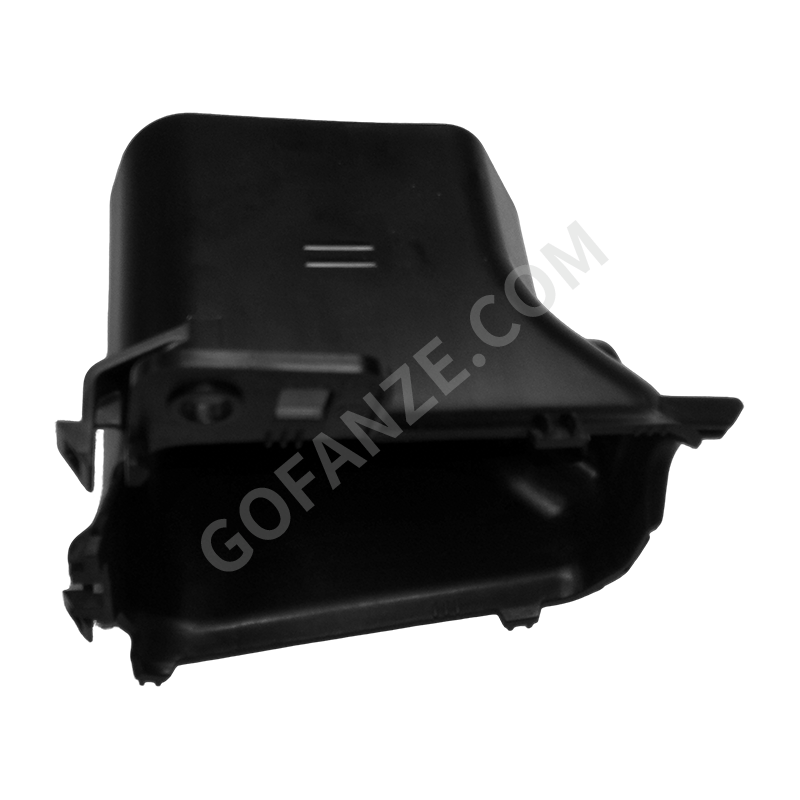
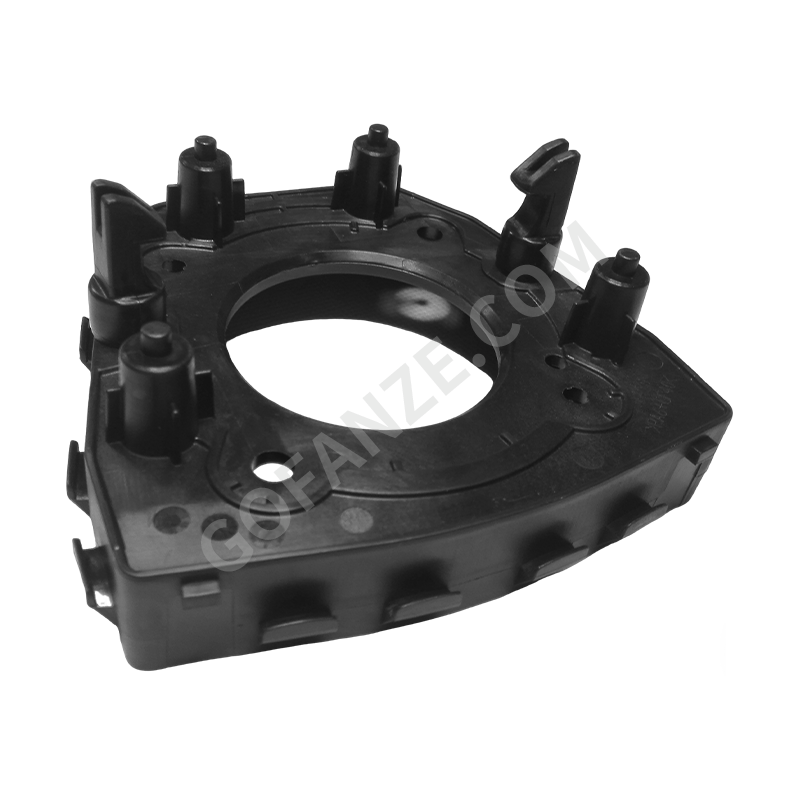

- Automotive interior plastic parts injection mold
- Automobile wire harness
- EV Charging pile plastic injection mold
- Motorcycle Fairings & Bodywork plastic injection mold
- High-Gloss Transparent PC injection mold
- Robot shell injection mold
- Home Appliance Injection Parts
- Threaded Plastic injection molded part
- Plastic Multi-way Connectors
- Two-color Plastic component & tool
- Printer Components & Parts

