


 English
 Français
 Español
 Deutsch

Home · News · Industry News · How Automotive Interior Plastic Parts Injection Molds Are Made | Process Guide
Industry News
How Automotive Interior Plastic Parts Injection Molds Are Made | Process Guide
2026-08-19Table of Contents
- 1 How Automotive Interior Plastic Parts Injection Molds Are Made: The Sequence
- 2 Design for Manufacture Starts With the Part Geometry
- 3 Steel Selection Determines Tool Life and Surface Quality
- 4 Precision Machining of the Core and Cavity
- 5 Assembly, Benching, and Surface Treatment
- 6 Mold Trial, Dimensional Validation, and Release
- 7 What a Mold Supplier Should Bring to an Interior Program
Before a single plastic pellet enters a molding press, an automotive interior component such as the instrument panel frame has already received about four hundred hours of tooling design and machining attention. The mold decides everything downstream: cycle time, dimensional stability, surface appearance, and reliability in high-volume assembly. This article follows the complete chain, from the first CAD review to the trial shot that releases the tool for production.
How Automotive Interior Plastic Parts Injection Molds Are Made: The Sequence
Every interior mold, regardless of vehicle program, follows the same sequence: part design review, mold layout, steel preparation, CNC and EDM machining, benching and assembly, polishing and texturing, then tryout and dimensional release. The order is not optional; each step builds on the previous one.
A large interior mold such as the instrument panel frame injection mold typically takes twelve to eighteen weeks from design kickoff to first production parts. A smaller component, such as a gear-shift bracket or a speaker cover, can be delivered in eight to ten weeks.
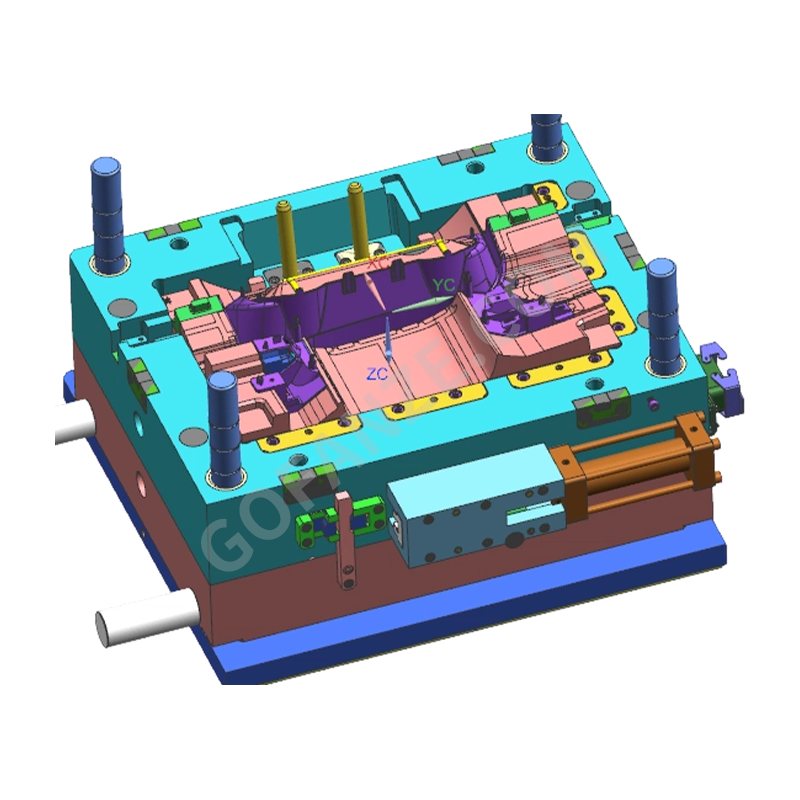 Wholesale Instrument Panel Frame Injection Mold Suppliers, Company, ExporterFanze T&M (Jiashan) Co., Ltd. Is China Wholesale Instrument Panel Frame Injection Mold Suppliers, Company, Exporter, This product line sp...View Product →
| Stage | Key activities | Typical duration |
|---|---|---|
| Design review and DFM | Draft angle, gate position, shrinkage, wall thickness | 1–2 weeks |
| Mold layout and detail design | Cooling circuit, slides, lifters, ejection system | 1–2 weeks |
| Steel preparation and rough machining | Plate procurement, rough milling | 2–3 weeks |
| Finish machining and EDM | 3D cavity finishing, sharp internal corners, inserts | 3–4 weeks |
| Benching, polishing, and texturing | Fitting, SPI finish, chemical grain etching | 1–2 weeks |
| Tryout, modification, and release | Process window, CMM check, initial production parts | 1–3 weeks |
Design for Manufacture Starts With the Part Geometry
A mold cannot be built from the part drawing alone. The tooling team first runs a design-for-manufacture review that checks draft angles, wall thickness consistency, gate position, and ejection points. Interior parts are unforgiving: an undrafted vertical wall can make ejection impossible, a locally thick section can create sink marks, and a poorly placed gate can leave weld lines exactly where the customer will see them. The DFM phase should also lock the mold steel size, the hot runner layout, and the target cycle time. The material and geometry decisions are covered in more detail in our guide on automotive interior plastic parts injection mold design principles and material selection.
Gate, Runner, and Cooling Layout
Hot runner systems are standard in automotive interior tooling because they allow precise, multi-point gating while eliminating cold runners from the molded part. Cooling is equally decisive. Channels are typically 8 to 12 mm in diameter, positioned about two channel diameters from the cavity wall. A well-balanced cooling layout shortens cycle time and prevents warpage on long parts such as the center stack carrier injection mold, where uneven heat removal translates directly into twist and bowing.
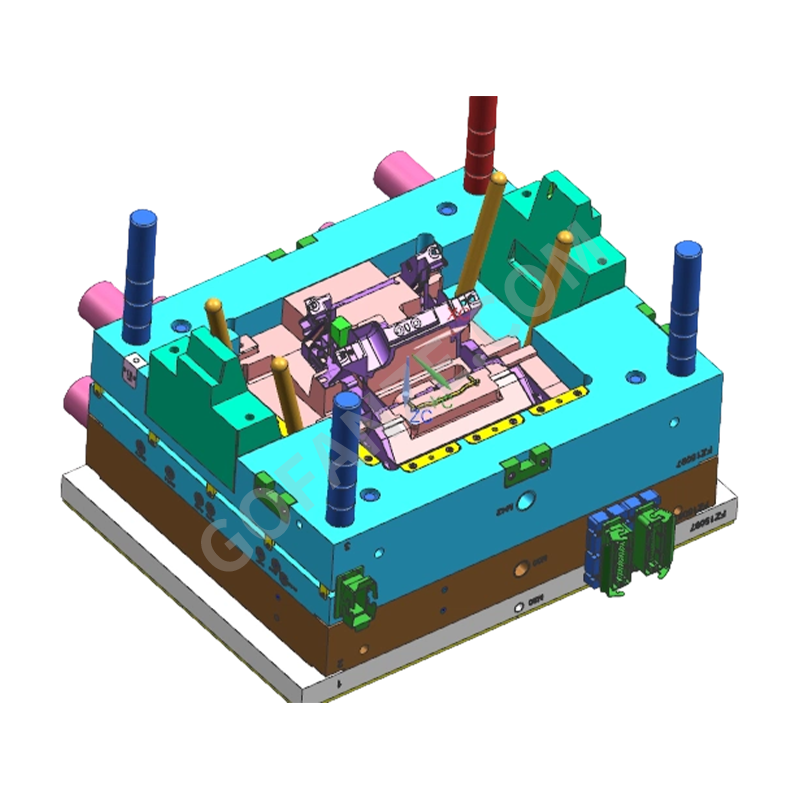 Wholesale Center Stack Carrier Injection Mold Suppliers, Company, ExporterFanze T&M (Jiashan) Co., Ltd. Is China Wholesale Center Stack Carrier Injection Mold Suppliers, Company, Exporter, The Center Console Bra...View Product →
Slides, Lifters, and Internal Actions
A modern interior mold rarely opens as a simple two-plate tool. Undercuts on the part — mounting clips, snap-fits, ventilation louvers, and damped box mechanisms — require slides and lifters. Slides move perpendicular to the opening direction, driven by angled pins or hydraulic cylinders. Lifters handle internal undercuts and release the part as the ejector system moves. The number of actions influences not only the tool price but also the maintenance schedule, because every moving component is a potential source of flash or wear.
Steel Selection Determines Tool Life and Surface Quality
Automotive interior molds run long production campaigns, so the choice of mold steel is made before cutting begins. Pre-hardened P20-type steel at roughly 36–40 HRC is common for short and medium runs, while H13 hardened to 48–52 HRC is specified for high-volume tools or glass-filled resins. For cavities that must accept fine grain etching or a mirror polish, stainless-type tool steel is preferred because it resists corrosion from cooling water and molding gases.
Cavity Steel for Class A Surfaces
The visible side of the part — the panel the driver sees under the windshield or on the console — is formed by the cavity steel. That surface requires a defined polish grade, usually SPI A-2 or finer, before a chemical grain texture is applied. Any porosity or grinding mark in the cavity repeats on every molded part.
Core Steel and Wear Components
The core half of the mold carries the interior geometry: ribs, bosses, and attachment points. This side takes more ejection force and sees the most contact with moving components. Wear-resistant inserts and hardened wear plates are placed wherever sliding steel meets steel, and that is also where the maintenance team will look first after a tool has run several hundred thousand cycles.
Precision Machining of the Core and Cavity
Machining starts with rough milling that removes the bulk of the material, then moves to high-speed finishing of the 3D surface. Three machining processes account for nearly all interior mold features.
| Process | Typical use in interior mold making | Geometric strength |
|---|---|---|
| CNC milling | 3D cavities, cores, slide bodies | Free-form surfaces in bulk steel |
| Sinker EDM | Rib bases, square corners, textured cavities | Sharp internal corners that cutters cannot reach |
| Wire EDM | Insert blanks, ejector holes, gate slots | Straight-through precision profiles |
During electrode cutting and EDM finishing, the part geometry is transferred into hardened steel with a level of repeatability that mechanical cutting alone cannot offer. The fine louver stack of an automotive air-conditioning vent plastic parts injection mold, for example, is normally EDM-finished because the blade slots are too narrow for an end mill and too sharp for a conventionally polished cavity.
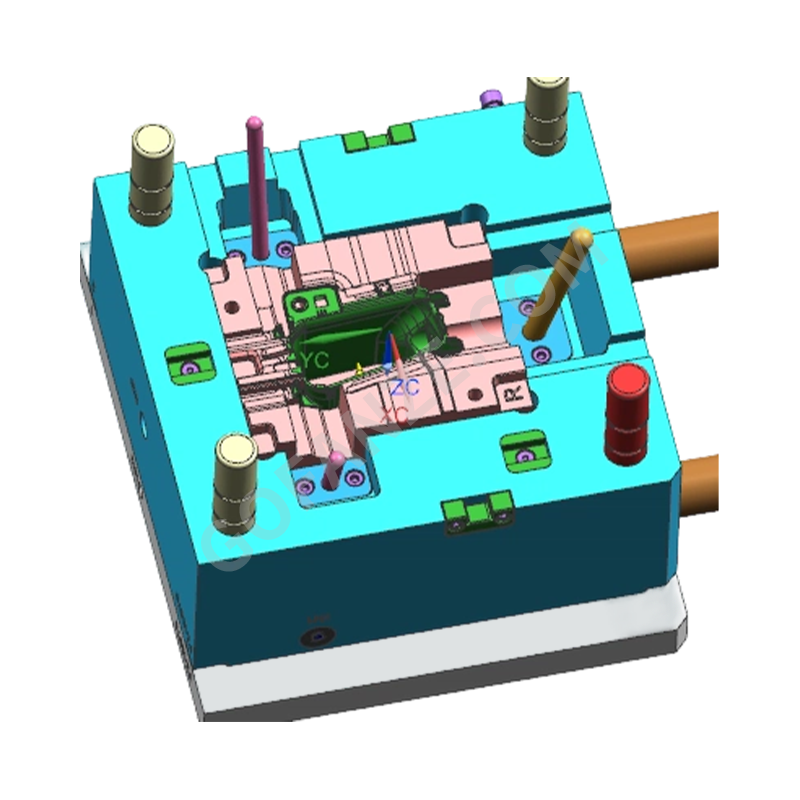 Wholesale Automotive Air Conditioning Vent Plastic Parts Injection Mold SupplierFanze T&M (Jiashan) Co., Ltd. Is China Wholesale Automotive Air Conditioning Vent Plastic Parts Injection Mold Suppliers, Company, Export...View Product →
Assembly, Benching, and Surface Treatment
Benching is where the machined components become a working tool. Fitters match the core and cavity, set slide clearances, align ejector pins, and adjust the parting line until it closes without visible mismatch. On an interior part, even a parting-line step of 0.05 mm is enough to generate complaints on a panel that sits in plain view.
After fitting, the cavity is polished to the specified SPI grade and, when required, chemically etched to produce a leather grain or brushed texture. Texturing is done after polishing because the etching process modifies only the top layer of steel. This combination of polish and etch is what gives interior trim its consistent look across thousands of molded parts.
Mold Trial, Dimensional Validation, and Release
The finished mold is mounted on a production-scale injection molding machine for tryout. Melt temperature, injection speed, holding pressure, and cooling time are varied in a controlled manner to find a process window that delivers uniform part weight, no short shots, and no flash. Short-shot trials with the actual resin show the flow front and confirm gate and venting behavior before full shots are evaluated.
Every trial part is measured against the CAD model, usually by CMM or white-light scanning. Interior mounting points often hold tolerances of ±0.05 mm or tighter, because the part must mate with neighboring components under a fixed assembly sequence. When critical dimensions remain stable across consecutive runs, the mold is approved for serial production.
For buyers evaluating dashboard tooling, the acceptance criteria described in our guide to choosing automotive interior plastic injection molding for dashboard programs explain what to check in trial parts, from wall-thickness distribution to surface quality.
What a Mold Supplier Should Bring to an Interior Program
An interior mold is not a commodity; it is a long-lived asset that determines part cost for years. The supplier should be able to demonstrate IATF 16949 certification, in-house machining with CNC, EDM, and wire-cut capacity, and practical experience in the same component category. Fanze T&M, a mold builder and molder operating since 2005 in Jiashan, China, combines precisely that structure: product development review, mold design, mold manufacturing, injection molding, and post-molding printing and assembly in one facility. That combination shortens correction loops because the team that cuts the cavity also runs the molding trials and sees the parts under production conditions.
When comparing suppliers, look for reference parts already running in the same plastic family — filled PP for large interior carriers, PC/ABS for decorative trim, PA66 for structural brackets — and for a documented release procedure that covers dimensional reports, material certifications, and process parameters. A tool that has been proven with the actual production resin is worth more than a tool that was merely CNC-cut to the CAD file. The key qualifications to verify are:
- IATF 16949 certification and a documented quality system.
- In-house CNC, EDM, and wire-cut capacity instead of fully outsourced machining.
- Proven reference parts in the same resin family and similar complexity.
- A release procedure that includes dimensional reports, material certificates, and process parameters.
For a broader view of how part design and manufacturing decisions interact, the injection plastic parts complete guide to design and manufacturing is a useful reference during early project planning.
From the first shrinkage calculation to the final dimensional report, automotive interior plastic parts injection molds are made through a controlled chain of design, machining, fitting, and validation decisions. The mold determines part quality before the press even closes for the first time. Buyers who understand that chain can assess quoted lead times, challenge missing process steps, and choose a supplier that treats the interior mold as a manufacturing system rather than a steel block.
Categories
- Company News(2)
- Industry News(32)
Product Category
-
Printer Components & Parts
-
Two-color Plastic component & tool
-
Plastic Multi-way Connectors
-
Threaded Plastic injection molded part
-
Home Appliance Injection Parts
-
Robot shell injection mold
-
High-Gloss Transparent PC injection mold
-
Motorcycle Fairings & Bodywork plastic injection mold
-
EV Charging pile plastic injection mold
-
Automobile wire harness
-
Automotive interior plastic parts injection mold
Related Tag
-
Automotive Interior Trim Plastic Parts Injection Mold
Automotive Dashboard Plastic Parts Injection Mold
Automotive Center Console Plastic Parts Injection Mold
Automotive Instrument Panel Plastic Parts Injection Mold
Automotive Air Vent Plastic Parts Injection Mold
High Precision Automotive Interior Plastic Parts Injection Mold
Hot Runner Automotive Interior Plastic Parts Injection Mold
Multi Cavity Automotive Interior Plastic Parts Injection Mold
Automotive Interior Plastic Components Injection Mold
Automotive Door Panel Plastic Parts Injection Mold

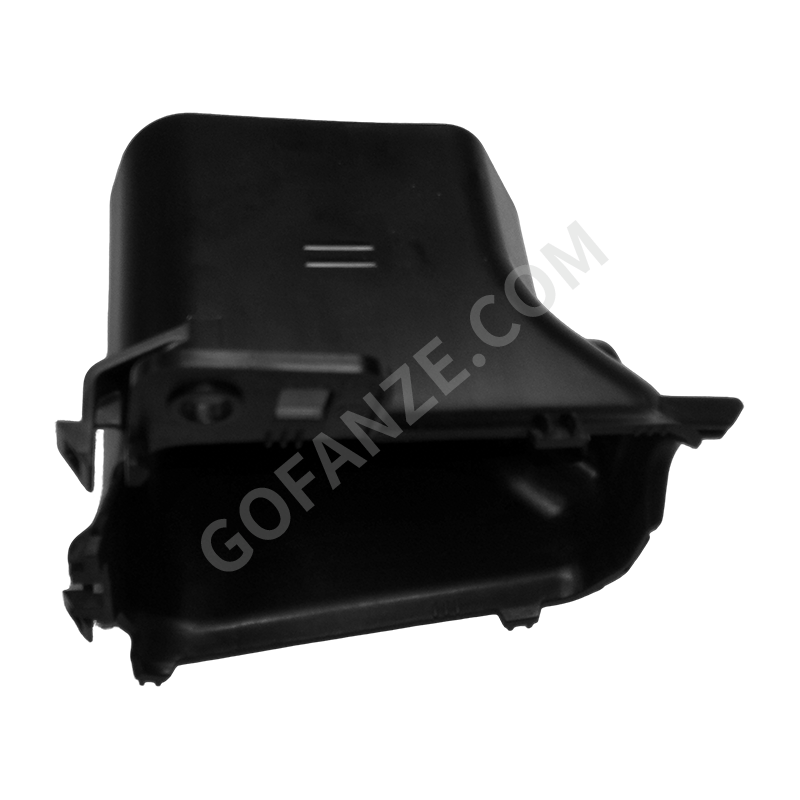

- Automotive interior plastic parts injection mold
- Automobile wire harness
- EV Charging pile plastic injection mold
- Motorcycle Fairings & Bodywork plastic injection mold
- High-Gloss Transparent PC injection mold
- Robot shell injection mold
- Home Appliance Injection Parts
- Threaded Plastic injection molded part
- Plastic Multi-way Connectors
- Two-color Plastic component & tool
- Printer Components & Parts

